Picture this: It’s a Tuesday morning in 2026, and a middle school teacher in Seoul walks into her classroom. Her students have already spent 20 minutes before class chatting with an AI tutor that diagnosed their individual learning gaps overnight. The AI has done the heavy lifting — it flagged that three students still struggle with algebraic reasoning, and two others are ready for advanced problem sets. So what exactly does she do now?
This scene isn’t hypothetical anymore. It’s Tuesday, and it’s happening. And honestly? The question of what teachers are for in the AI age is one of the most fascinating — and urgent — puzzles we need to work through together.
Let’s think through this carefully, because the answer isn’t as simple as “AI replaces teachers” or “nothing changes.” The reality is far more nuanced, and frankly, more exciting.
📊 What the Data Actually Tells Us About AI in Education
Before we jump to conclusions, let’s ground ourselves in what’s actually happening. According to OECD’s 2025 Education at a Glance report, approximately 67% of schools across OECD nations had integrated some form of AI-assisted learning tools by late 2025 — a staggering jump from just 23% in 2022. Meanwhile, a McKinsey Global Institute analysis published in early 2026 estimated that roughly 40–45% of traditional teaching tasks — including content delivery, quiz generation, homework grading, and basic progress tracking — are now automatable with existing AI systems.
But here’s the critical detail most headlines miss: the same report found that teacher-to-student emotional engagement metrics (measured through self-reported student wellbeing surveys) remained strongly correlated with academic outcomes — more so now than five years ago. Why? Because when AI handles the rote work, the remaining human interactions carry more weight, not less.
Think about it this way: if a nutritionist’s job was mostly writing down calorie counts, and an app now does that automatically, the nutritionist isn’t redundant — they’re freed to do the real work of behavioral coaching, emotional support, and personalized strategy. Teaching is undergoing exactly that kind of shift.
🔍 Breaking Down What’s Actually Changing (And What Isn’t)
Let me map this out clearly, because I find a lot of the public discourse bundles together very different kinds of change:
- Content Delivery: AI adaptive learning platforms like Khan Academy’s Khanmigo, China’s Squirrel AI, and South Korea’s CLOVA Tutor can now deliver personalized micro-lessons at scale. This part of teaching — standing at a board explaining the same concept to 30 students at different levels — is genuinely being disrupted.
- Assessment & Feedback: Automated grading for essays (yes, even nuanced ones) has improved dramatically. Tools in 2026 can now provide detailed rubric-based feedback on student writing with reasonable accuracy. This used to consume enormous teacher time.
- Curriculum Design: AI can now suggest lesson sequences based on class-wide performance data. Teachers still make final calls, but the cognitive labor of planning from scratch is significantly reduced.
- Mentorship & Emotional Support: This remains stubbornly, beautifully human. A student going through a family crisis, a teenager questioning their identity, a struggling learner who needs someone to believe in them — no AI navigates this well, and the research consistently shows it shouldn’t try to be the primary source.
- Critical Thinking Facilitation: Socratic discussion, debate facilitation, helping students sit with productive confusion — these are skills that require human judgment about group dynamics, emotional temperature, and intellectual readiness in real time.
- Community Building: Classrooms are social ecosystems. Teachers manage conflict, build belonging, model respectful disagreement. This is deeply relational work.
🌍 Real-World Examples: What Teachers Are Actually Becoming
Let’s look at how this is playing out in practice around the world, because theory only gets us so far.
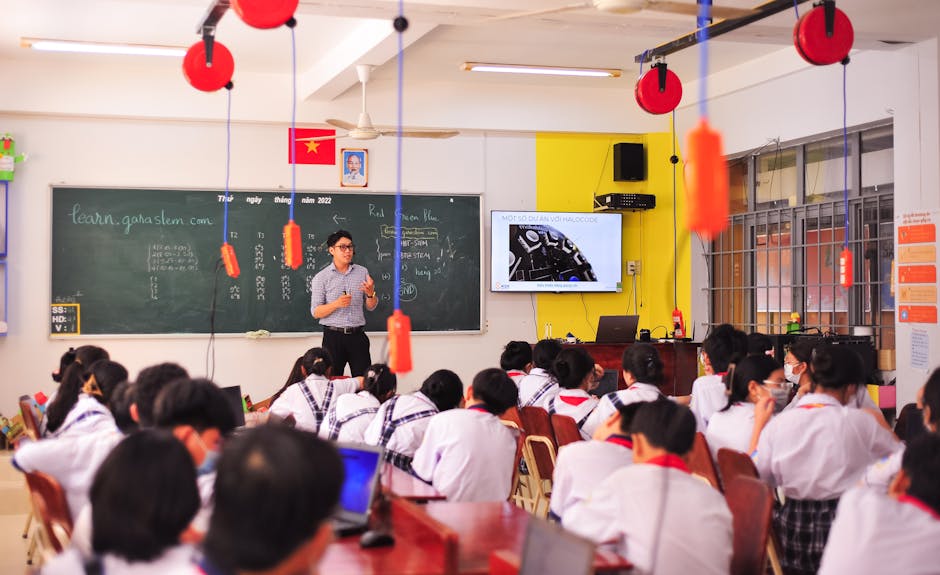
Finland’s “Teacher as Learning Coach” Model: Finland overhauled its teacher training curriculum in 2024 to explicitly prepare educators as learning process facilitators rather than subject-matter broadcasters. Finnish teachers now spend significantly more classroom time on project-based inquiry, where students pursue open-ended questions with AI tools as research assistants and the teacher circulates as a thinking partner — asking probing questions, identifying when a student is stuck in unproductive confusion versus productive struggle.
South Korea’s AI-Human Hybrid Classroom: South Korea, which has one of the highest rates of AI adoption in K-12 education globally, launched its national “AI NEIS 3.0” platform in 2025. Interestingly, teachers reported in a 2026 Korean Education Development Institute survey that they were spending 31% more time on one-on-one student conversations than before — time that was previously consumed by grading and lesson prep. The teachers who adapted best described themselves as “diagnosticians” — using AI data to identify exactly which student needed what kind of human intervention.
Kenya’s Low-Tech, High-Impact Adaptation: Not every context involves cutting-edge tech, and this is important. In Kenya’s rural school districts, where tablet-based AI tutors were introduced through the USAID-partnered EdTech program in 2025, teachers found their role shifting toward what researchers called “bridge building” — helping students connect AI-delivered content to their lived community experiences. Teachers became cultural translators and relevance architects in ways that made learning stick.
The “Teacher as Ethical Guide” Emergence in the EU: The EU’s AI in Education Framework (updated in March 2026) now requires that schools appoint designated teachers as AI literacy educators — responsible for helping students understand how AI tools work, what their biases might be, and how to think critically about AI-generated information. This is an entirely new professional competency that didn’t exist five years ago.

🤔 The Uncomfortable Questions We Need to Sit With
I want to be honest here — this transition isn’t purely rosy. There are real tensions worth acknowledging.
First, there’s the equity problem. If AI tools are primarily available in well-resourced schools, we risk creating a two-tier system where wealthy students get AI-augmented teachers (the best of both worlds) while underfunded schools get under-resourced teachers without AI support. This is a policy challenge, not a technological one, but it’s urgent.
Second, there’s the teacher identity crisis. Many teachers entered the profession because they love their subject — they’re passionate mathematicians, literature lovers, history enthusiasts. When AI can deliver subject content more efficiently, some teachers report feeling that their core identity is being hollowed out. Reframing the role requires not just new skills training but a genuine philosophical shift about what teaching means.
Third, there’s the question of what we’re optimizing for. AI tools are excellent at measurable outcomes — test scores, completion rates, skill mastery. But education has always been partly about unmeasurable things: developing curiosity, building character, learning to be a citizen. We need to be careful that the efficiency gains from AI don’t crowd out the harder-to-measure human development work that teachers have always done.
💡 Realistic Alternatives: How Teachers Can Navigate This Transition
So if you’re a teacher reading this — or someone who cares about education — what does a practical, grounded response look like? Here are my honest suggestions:
- Lean into what AI genuinely can’t replicate: Your ability to read a room, notice a student who’s quietly struggling, build trust over months — these are your superpower in 2026. Double down intentionally.
- Become an AI-literate practitioner, not an AI-resistant one: You don’t need to be a data scientist, but understanding what your school’s AI tools actually measure (and what they miss) makes you a far more effective decision-maker. Ask vendors hard questions.
- Redesign your lesson time deliberately: If AI handles explanation and basic practice, what will you use that reclaimed time for? Don’t let it get filled with administrative drift. Plan for richer discussion, project work, or deeper individual conferences.
- Advocate for teacher input in AI tool selection: Too many edtech tools are chosen by administrators without teacher consultation. Push for professional voice in these decisions — you’re the one who knows whether a tool actually serves learning.
- Connect with a professional learning community: The teachers navigating this best are learning from each other, not just from top-down training. Find your people — locally or through platforms like Edutopia’s 2026 teacher networks.
- Don’t neglect your own wellbeing: Ironically, if AI is reducing your grading burden, that cognitive space can be quickly refilled with anxiety about relevance. Be intentional about processing this transition — it’s genuinely significant.
The teachers who will thrive in 2026 and beyond aren’t the ones who resisted AI or the ones who surrendered to it. They’re the ones who developed a clear, confident sense of their unique human value — and used AI to free up time to express it more fully.
The role isn’t disappearing. It’s being purified, in a way — stripped of its more mechanical elements and left with the parts that were always the heart of it: relationship, inspiration, guidance, and the quiet belief that each student is capable of more than they yet know.
Editor’s Comment : What strikes me most about this conversation is that we’ve been having a version of it throughout history — the printing press, the calculator, the internet each triggered fears about teacher obsolescence. And each time, the best educators didn’t fight the tool or disappear into it. They found the new frontier of human value that the tool couldn’t reach. In 2026, that frontier is clearer than ever: it lives in the space between two people, in the moment a student feels genuinely understood. No algorithm has gotten there yet. And I suspect that’s where teachers will always live.
📚 관련된 다른 글도 읽어 보세요
- 2026년 AI 리터러시 교육, 학생이 반드시 갖춰야 할 핵심 역량 7가지
- 놀이치료 효과, 유아 심리 발달에 정말 도움이 될까? 실제 사례로 알아보기 [2026]
- 아동 자존감 향상 육아법 – 2026년 전문가들이 강조하는 5가지 핵심 습관
태그: [‘AI in Education 2026’, ‘Teacher Role Transformation’, ‘Future of Teaching’, ‘EdTech Trends 2026’, ‘AI Classroom Technology’, ‘Education Innovation’, ‘Human-AI Collaboration in Schools’]
Leave a Reply