Picture this: your 18-month-old toddles over, points dramatically at the family dog, and announces “Dah!” with absolute conviction. You smile, nod, repeat the word back — and somewhere in that tiny brain, a neural pathway just lit up like a firework. That moment? It’s not random. It’s part of one of the most meticulously orchestrated developmental journeys in human biology.
As a parent or caregiver, understanding the stage-by-stage arc of early childhood language development can feel like suddenly being handed the instruction manual you never knew you needed. So let’s dig into what current research tells us — and more importantly, what it means for your everyday life with a little one in 2026.
Why Language Development Deserves a Closer Look
Language isn’t just about words. It’s the scaffolding for cognitive reasoning, emotional regulation, social bonding, and academic readiness. According to the American Speech-Language-Hearing Association (ASHA), children who experience language delays in their first three years are significantly more likely to face reading difficulties by age seven. And a 2024 longitudinal study from the University of Melbourne — whose follow-up data was published in early 2026 — confirmed that responsive verbal interaction before age two is one of the strongest predictors of school-age literacy.
So yeah, this stuff matters. A lot. Let’s walk through the stages together.
Stage 1: Pre-Linguistic Communication (Birth – 6 Months)
Before your baby utters a single recognizable word, they are already communicating — loudly and clearly. Crying, of course, is the first tool, but watch for subtler signals too.
- Cooing (6–8 weeks): Those soft, vowel-like sounds (“ooh,” “aah”) signal the larynx is warming up for bigger performances ahead.
- Social smiling (around 6–8 weeks): This is communicative, not just adorable — it’s a child learning turn-taking, the foundation of conversation.
- Differential crying: Research shows that by week 3–4, caregivers can often distinguish hunger cries from discomfort cries. Babies are already encoding meaning into sound.
- Gaze following (4–6 months): When your baby tracks your eyes to see what you’re looking at, they’re learning joint attention — a cornerstone of language.
What this means for you: Talk to your newborn constantly. Narrate your day. It’s not weird; it’s neurologically essential. The brain is building its “sound map” of your native language before age six months.
Stage 2: Babbling Begins (6 – 12 Months)
Around six months, something magical happens: consonants arrive. Suddenly you’re hearing “ba-ba-ba,” “ma-ma-ma,” “da-da-da” — and yes, your heart melts, even though they don’t mean you yet.
- Canonical babbling (6–8 months): Repetitive consonant-vowel combinations. This is practice — the vocal equivalent of scales before a piano recital.
- Variegated babbling (9–12 months): Now the combinations vary: “ba-da-ga.” This mirrors the cadence and rhythm of actual speech — called prosody — in your native language.
- Proto-words (10–12 months): Consistent sound-meaning pairings that only the family understands. “Nuh-nuh” might always mean “I want milk.” That’s a word in every meaningful sense.
A fascinating cross-cultural study out of Seoul National University’s Child Development Lab, whose 2026 report tracked 400 infants across Korean, English, and Mandarin-speaking homes, found that infants as young as 7 months begin filtering out phonemes not present in their native language. This is known as phonetic narrowing, and it means the window for multi-language exposure is genuinely time-sensitive.
Stage 3: First Words (12 – 18 Months)
The milestone every parent circles on the calendar. On average, a child says their first recognizable word around their first birthday — though “average” here has wide, perfectly normal margins (anywhere from 9 to 14 months).
- First words are typically: Names of important people (“mama,” “dada”), favorite objects (“ball,” “cup”), and action words (“up,” “go,” “more”).
- Vocabulary at 12 months: Approximately 1–5 words.
- Vocabulary at 18 months: Typically 10–50 words, though some children are still solidly within normal range at fewer.
- Comprehension leads production: A toddler typically understands 2–3 times more words than they can say. Don’t underestimate that quiet child — they may be absorbing everything.
Realistic note: If your child isn’t saying words by 16 months but is pointing, making eye contact, and understanding simple instructions, that’s a different picture than a child who isn’t communicating at all. Context matters enormously — always discuss concerns with your pediatrician rather than relying on a checklist alone.
Stage 4: The Vocabulary Explosion (18 – 24 Months)
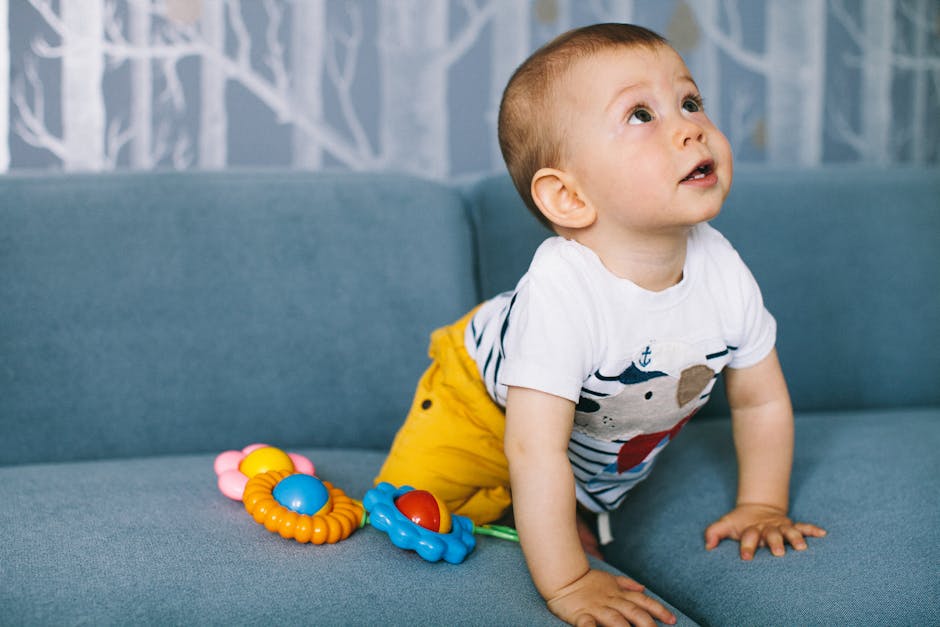
Somewhere between 18 and 24 months, most children hit what linguists call the vocabulary burst or naming explosion — a phase where they seem to acquire new words almost daily. This isn’t coincidence; it coincides with a cognitive leap where toddlers understand that everything has a name.
- Children may add 5–10 new words per week during this burst.
- Two-word combinations emerge: “more milk,” “daddy go,” “big dog.”
- The concept of fast mapping kicks in — toddlers can associate a new word with its referent after just one or two exposures.
- Pronouns begin appearing, though often incorrectly at first (“me want” instead of “I want”).
The Hart & Risley research (foundational, though now heavily updated) and its modern successors — including a 2026 meta-analysis published in the journal Child Development — continue to reinforce the concept of “serve and return” interactions: when a child vocalizes and a caregiver responds meaningfully, neural connections multiply. Quantity AND quality of parent talk both matter.
Stage 5: Simple Sentences & Grammar Emergence (2 – 3 Years)
Two-year-olds are linguistic adventurers. By their second birthday, most are stringing together 2–3 word phrases. By their third, full sentences of 4–6 words are common — complete with charming grammatical errors that are actually signs of healthy rule-learning.
- “I goed to the park” — “goed” is a mistake, but it proves the child has learned the rule for past tense and is applying it. That’s sophisticated cognition.
- Questions emerge (“What dat?”, “Where daddy go?”).
- Negation develops: first “no” as a standalone protest, then embedded in sentences (“I no want it”).
- By 36 months, strangers should be able to understand about 75% of what a child says. Familiar caregivers typically understand more.
South Korea’s 2026 National Child Health Survey — which tracked 12,000 children aged 2–5 — found that children in daycare settings with structured storytime and song-based learning showed measurably higher MLU (Mean Length of Utterance, a key developmental metric) compared to peers with less structured verbal exposure. This aligns with findings from Finland’s renowned early childhood education system, where language-rich environments are a formal policy priority from infancy onward.
Stage 6: Complex Language & Narrative Thinking (3 – 5 Years)
By preschool age, language development shifts from vocabulary acquisition into something richer: storytelling, reasoning, and social nuance. This is where pragmatic language — knowing how to use language appropriately in social contexts — takes center stage.
- Children begin constructing narratives with a beginning, middle, and end — even if the plot involves a dinosaur, a grocery store, and their baby sister.
- Metalinguistic awareness emerges: children start understanding that words are symbols, rhymes are patterns, letters represent sounds. This is pre-literacy in action.
- By age 4–5, most children use complex sentences, ask clarifying questions, and adjust their language depending on their audience (simpler with babies, more complex with adults).
- Bilingual children at this stage may code-switch fluidly — mixing languages in a single sentence — which is not a sign of confusion but of sophisticated linguistic management.
Red Flags Worth Knowing (And What to Do)
Developmental timelines are guides, not verdicts. But certain patterns do warrant early professional input:
- No babbling by 12 months
- No single words by 16 months
- No two-word phrases by 24 months
- Any loss of previously acquired language skills at any age
- Consistent difficulty being understood by familiar people after age 3
Early Speech-Language Therapy (SLT) is vastly more effective than a wait-and-see approach. Many pediatric speech therapists in 2026 now offer hybrid in-person and telehealth sessions, making access considerably easier than even five years ago. The earlier intervention begins, the better the outcomes — full stop.
Realistic Everyday Strategies That Actually Work
You don’t need flashcards or expensive apps. Here’s what research consistently shows makes the biggest difference:
- Narrate your world: “I’m washing the dishes now. The water is warm. This is the blue bowl.” This is called parallel talk, and it builds vocabulary in context.
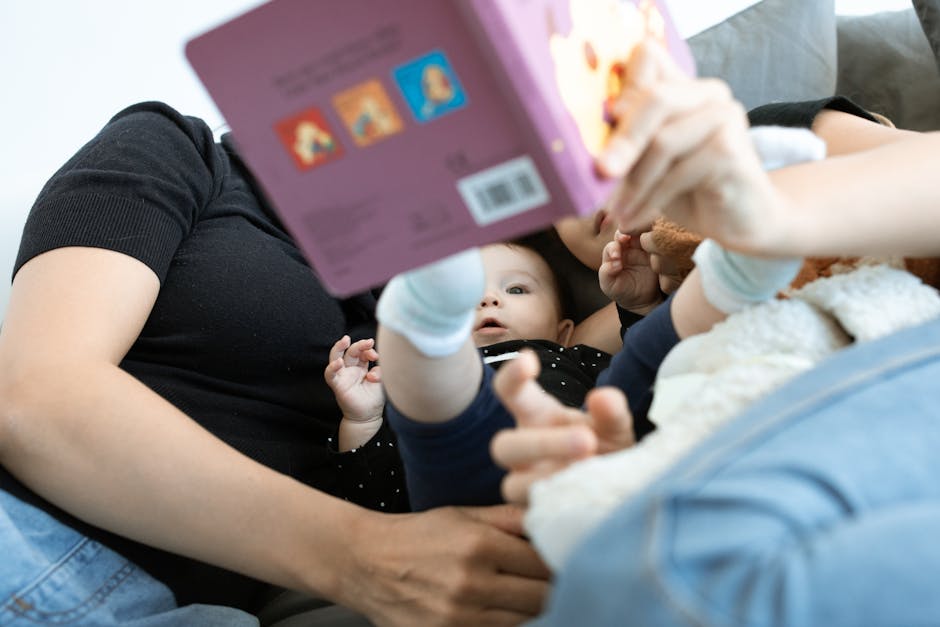
- Read together daily: Even just 10–15 minutes of shared book reading dramatically accelerates vocabulary and comprehension. Let them turn the pages. Talk about the pictures, not just the text.
- Follow their lead: If they’re obsessed with trucks, learn every truck word there is. Interest-driven vocabulary sticks.
- Expand, don’t correct: If they say “doggie runned,” respond with “Yes! The doggie ran fast!” You’ve modeled the correct form without shutting them down.
- Limit passive screen time: The American Academy of Pediatrics still recommends minimal solo screen time for under-2s in their 2026 updated guidelines. Interactive video calls with grandparents? Those count as real conversation.
- Sing songs and nursery rhymes: Rhythm and rhyme are neural highways to phonological awareness — the precursor to reading.
Language development is one of the most awe-inspiring things you’ll ever have a front-row seat to. It’s messy, non-linear, deeply individual — and absolutely worth paying attention to. The good news? You don’t need to be a linguist. You just need to show up, talk, listen, and respond. That’s it. That’s the whole game.
Editor’s Comment : In 2026, with so much parenting content competing for our attention, it’s easy to either panic about milestones or dismiss concerns entirely. The healthiest approach lives in the middle: stay curious, stay engaged, and don’t hesitate to loop in a professional if something feels off. Your instincts as a caregiver are data too — and they’re worth taking seriously. Every child’s language journey is uniquely their own, but the destination — confident, connected communication — is worth every “dah!” along the way.
태그: [‘toddler language development 2026’, ‘infant speech milestones’, ‘early childhood language stages’, ‘baby language development guide’, ‘speech delay red flags’, ‘vocabulary development toddlers’, ‘early childhood education language’]
Leave a Reply