Picture this: a 9-year-old confidently explaining to her grandmother how she built a simple chatbot that recommends weekend activities. That’s not a scene from a tech camp brochure anymore — it’s happening in regular elementary school classrooms in 2026. When my neighbor’s daughter casually mentioned that her third-grade class spent the afternoon “training a mini AI model” to sort fruit images, I realized we’ve crossed a genuine threshold. AI coding education isn’t the future of elementary school — it’s the present, and it’s moving faster than most of us expected.
So let’s think through this together: what does a solid AI coding curriculum for elementary school actually look like, why does it matter, and what should you realistically expect if you’re a parent, teacher, or school administrator navigating this space right now?

Why Elementary School? Isn’t That Too Young?
This is the most common pushback, and it’s a fair one. The concern usually goes: “Shouldn’t kids be learning reading and arithmetic first?” The short answer is — yes, and also this. Research from the MIT Media Lab and follow-up studies published through 2025 show that children between ages 6 and 11 are in a critical window for computational thinking, the foundational logic layer that makes both coding and AI literacy possible. It’s less about syntax and more about structured problem-solving.
According to a 2026 OECD report on digital education readiness, countries that introduced computational thinking at the elementary level saw measurably higher STEM engagement scores by middle school — roughly 34% higher problem-solving confidence scores compared to cohorts that started in secondary school. That’s not a small gap.
What a Well-Designed AI Coding Curriculum Actually Covers
Here’s where it gets interesting, because “AI coding curriculum” can mean wildly different things depending on the school. Let me break down what a thoughtful, age-appropriate program in 2026 typically includes across grade bands:
- Grades 1–2 (Ages 6–8): Unplugged Computational Thinking — No screens required. Activities like sorting algorithms with physical cards, pattern recognition games, and “if-then” decision trees using real-world scenarios. The goal is building logical sequencing in the brain before any device is introduced.
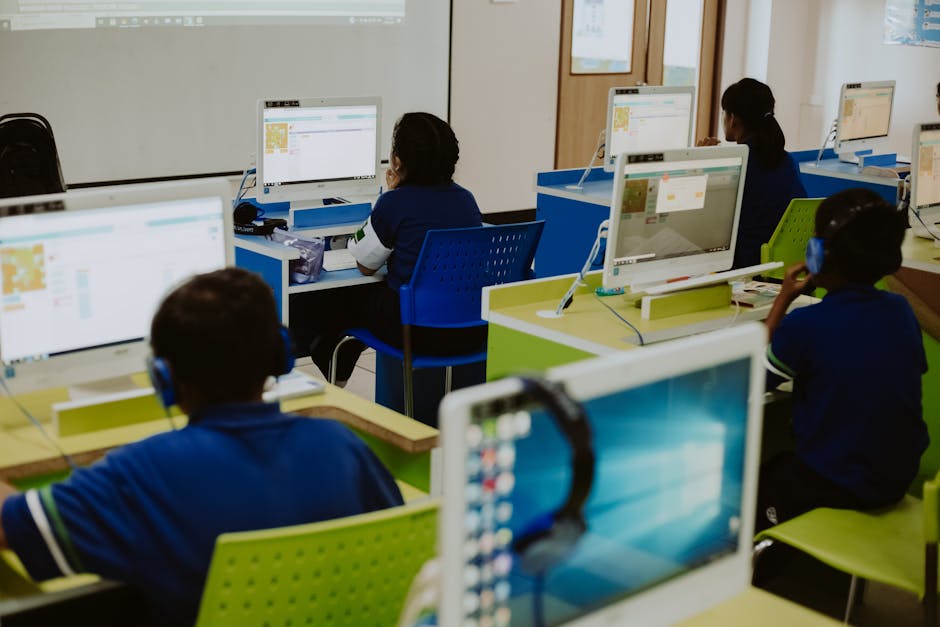
- Grades 3–4 (Ages 8–10): Block-Based Coding + AI Concepts — Platforms like Scratch 4.0 (updated in late 2025 with AI modules) and MIT App Inventor allow students to drag-and-drop logic blocks. Crucially, newer versions include simple machine learning demonstrations — kids can train image classifiers with their own drawings.
- Grades 5–6 (Ages 10–12): Text-Based Introduction + Ethical AI — Students begin exploring Python basics through guided environments like micro:bit or Google’s Teachable Machine. Equally important: structured discussions about bias in AI, data privacy, and what it means when an algorithm makes a decision.
The Ethics Layer — Often Missing, Always Critical
Here’s something that separates an adequate curriculum from an excellent one: the inclusion of AI ethics as a core subject, not an afterthought. A 10-year-old who can build a simple image classifier but has never been asked “what happens if your training data only includes one type of person?” is technically capable but conceptually incomplete. The best programs in 2026 weave ethical reasoning into every unit, not just a standalone “digital citizenship” module at the end of the year.
Global and Domestic Examples Worth Paying Attention To
Let’s look at what’s actually working out in the real world, because that’s where theory gets tested:
South Korea’s AI Convergence Education Initiative (2026 Expansion): South Korea mandated AI literacy education nationwide across all elementary grades starting in 2025, with a significant curriculum expansion in 2026. The program uses a scaffolded approach where AI concepts are embedded into existing subjects — science classes use AI-powered data collection tools, and even art classes explore generative AI as a creative medium while discussing authorship.
Finland’s Cross-Disciplinary Model: Finland, consistently a global leader in education innovation, doesn’t treat AI coding as a standalone subject. Instead, computational thinking is woven into project-based learning across subjects. A unit on ecology might involve students building a simple environmental data tracker using sensors and basic code. The result: kids don’t see coding as “computer class” — they see it as a tool for understanding the world.
Singapore’s AI for Students Framework: Singapore’s Ministry of Education rolled out an updated AI literacy framework in early 2026 that explicitly distinguishes between using AI tools and understanding AI systems. Elementary students are assessed on both — can they use an AI tool effectively, and can they explain in simple terms what’s happening under the hood? This dual-track approach is worth emulating.
United States (Patchwork Progress): The U.S. remains inconsistent, with strong pockets of excellence — districts in Colorado, Massachusetts, and Washington state have robust AI coding programs — but significant gaps in rural and lower-income areas. The CS for All initiative has expanded funding in 2026, but implementation quality varies enormously by district.
What Tools and Platforms Are Schools Actually Using?
- Scratch 4.0 — Updated with AI/ML modules, free, browser-based, massive global community
- Google’s Teachable Machine — Allows kids to train real machine learning models using webcam, microphone, or file inputs — no code required initially
- micro:bit v3
- Code.org AI Courses — Structured curriculum with teacher guides; free; aligned to U.S. standards but usable globally
- Tynker AI — Subscription-based but school-friendly; includes dedicated AI and machine learning modules for elementary levels
— Physical computing device used widely in UK and increasingly in Asia; excellent for bridging digital and physical worlds
Realistic Alternatives for Different Situations
Not every school is ready to roll out a comprehensive AI curriculum tomorrow, and that’s okay. Let’s think through realistic paths forward based on where you actually are:
If your school has limited tech resources: Start with unplugged computational thinking — no devices needed. CS Unplugged (csunplugged.org) offers free, printable activities that build the same foundational skills. Once the conceptual groundwork is laid, even a single shared tablet per classroom can support meaningful block-based coding exploration.
If you’re a parent wanting to supplement at home: Platforms like Scratch, Khan Academy’s computing courses, and the free tiers of Tynker are excellent starting points. More importantly, encourage your child to ask “why” about every AI tool they encounter — voice assistants, recommendation algorithms on streaming platforms, autocomplete. That critical questioning habit is the foundation of true AI literacy.
If you’re a teacher with curriculum flexibility but limited training: Code.org offers free professional development programs that have been updated for 2026, including specific AI and machine learning educator tracks. You don’t need to be a programmer — you need to be a curious learner alongside your students, which is actually a pedagogically powerful position to be in.
If you’re a school administrator building a program from scratch: Resist the urge to purchase a single “AI curriculum in a box” solution and call it done. The most effective programs in 2026 are built around teacher capacity, not just software licenses. Invest in professional development first, pilot in two or three classrooms, measure outcomes carefully, and scale what works.
Editor’s Comment : What strikes me most about the current moment in elementary AI education is that the gap between schools doing this thoughtfully and schools doing it superficially is already becoming visible — and it will only widen. The goal was never to produce elementary school programmers. It’s to raise a generation of people who understand, question, and shape the AI systems that will define their adult lives. The schools getting this right aren’t just teaching kids to code; they’re teaching them to think critically about power, bias, and design. That’s the real curriculum, and honestly, it’s one adults could use too.
태그: [‘AI coding curriculum elementary school’, ‘elementary school AI education 2026’, ‘computational thinking for kids’, ‘coding for children’, ‘AI literacy education’, ‘STEM education primary school’, ‘teaching AI to elementary students’]
Leave a Reply