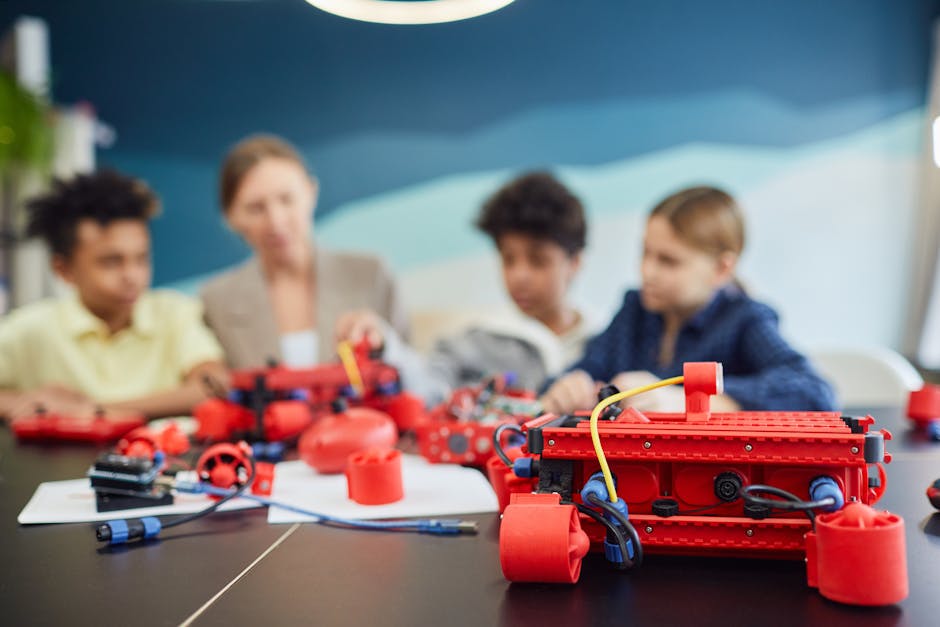
Picture this: It’s a typical Tuesday morning, and a 14-year-old named Mia is debugging a small machine-learning model she built to sort her family’s recycling. Her younger brother is in the next room, using an AI-assisted math tutor to prep for his weekend robotics competition. Meanwhile, their neighbor — a 40-something professional who never touched code in school — is frantically enrolling in an online STEM bootcamp because his logistics job is being restructured around automation. Three very different situations, but they all point to the same urgent truth: STEM education is no longer a niche advantage — it’s a survival skill for the modern economy.
Whether you’re a parent weighing your kid’s extracurriculars, an adult considering a career pivot, or a curious mind just trying to understand where the world is heading, let’s think through this together — because the stakes have genuinely never been higher.
📊 The Numbers Don’t Lie: Where the Jobs Are Going
Let’s ground this in reality. According to the World Economic Forum’s Future of Jobs Report 2026, over 85 million jobs globally are expected to be displaced by automation and AI-driven systems by 2030 — but simultaneously, 97 million new roles are projected to emerge, the vast majority of which require some level of STEM literacy. That’s not a net loss — it’s a massive transformation.
In the United States, the Bureau of Labor Statistics projects STEM occupations will grow at roughly twice the rate of non-STEM fields through the end of this decade. In South Korea, the government’s 2026 National AI Strategy earmarks over ₩3 trillion won specifically for STEM pipeline development from elementary school through university. The signal is unmistakable across borders: governments and corporations alike are betting enormous resources on people who can think technically.
But here’s the nuance many people miss — STEM education isn’t just about producing engineers and data scientists. It’s about developing a problem-solving framework that applies to medicine, law, policy, design, and even art. When we talk about STEM literacy in 2026, we’re really talking about computational thinking, data interpretation, and the ability to work alongside intelligent systems rather than be replaced by them.
🌍 What’s Working Around the World: Real Examples Worth Knowing
Let’s look at some compelling real-world models that are actually delivering results:
Finland’s Phenomenon-Based Learning: Finland overhauled its national curriculum to integrate STEM not as isolated subjects, but through cross-disciplinary “phenomena” — real-world problems like climate change or urban mobility that require math, science, and technology to unpack. The result? Finnish students consistently rank among the top globally in scientific reasoning, and notably, girls participate at equal rates in STEM subjects — a gap that plagues many other nations.
Singapore’s Applied Learning Programme (ALP): Singapore introduced ALPs across secondary schools, requiring students to apply STEM concepts to authentic industry contexts — from biosensor design to smart city logistics. By 2026, over 90% of Singapore secondary schools have a designated STEM-focused ALP track. Employers there report a measurably stronger pipeline of job-ready graduates compared to a decade ago.
South Korea’s SW·AI Education Mandate: South Korea made software and AI education compulsory at the elementary level starting in 2025, with expanded curriculum hours rolling out through 2026. The initiative isn’t just about coding — it’s structured to teach logical sequencing, ethical AI use, and creative problem-solving from age 8 onward.
Kenya’s Competency-Based Curriculum (CBC): Often overlooked in Western conversations, Kenya’s CBC reform places STEM integration at its core, with a specific focus on making it accessible in low-resource environments — using offline tools, local language instruction, and community-relevant projects like agricultural technology and water system modeling. It’s proof that STEM education doesn’t require a $50,000-per-year private school.
🎯 What STEM Education Actually Develops (Beyond the Obvious)
When parents hear “STEM education,” many immediately picture a child glued to a screen learning to code. That’s one small piece of a much larger picture. Here’s what well-designed STEM education is actually building:
- Systems Thinking: The ability to understand how components interact within a whole — invaluable in everything from healthcare management to supply chain design.
- Quantitative Reasoning: Reading data critically, spotting misleading statistics, and making evidence-based decisions — an essential skill in an era drowning in misinformation.
- Iterative Problem-Solving: The “build → test → fail → improve” cycle that engineering teaches is directly applicable to entrepreneurship, creative projects, and personal decision-making.
- Collaboration Under Complexity: Real STEM projects require diverse teams — teaching kids to communicate technical ideas clearly to non-technical people is a leadership superpower.
- Ethical Reasoning About Technology: As AI becomes embedded in courts, hospitals, and schools, the ability to ask “should we?” alongside “can we?” is genuinely critical.
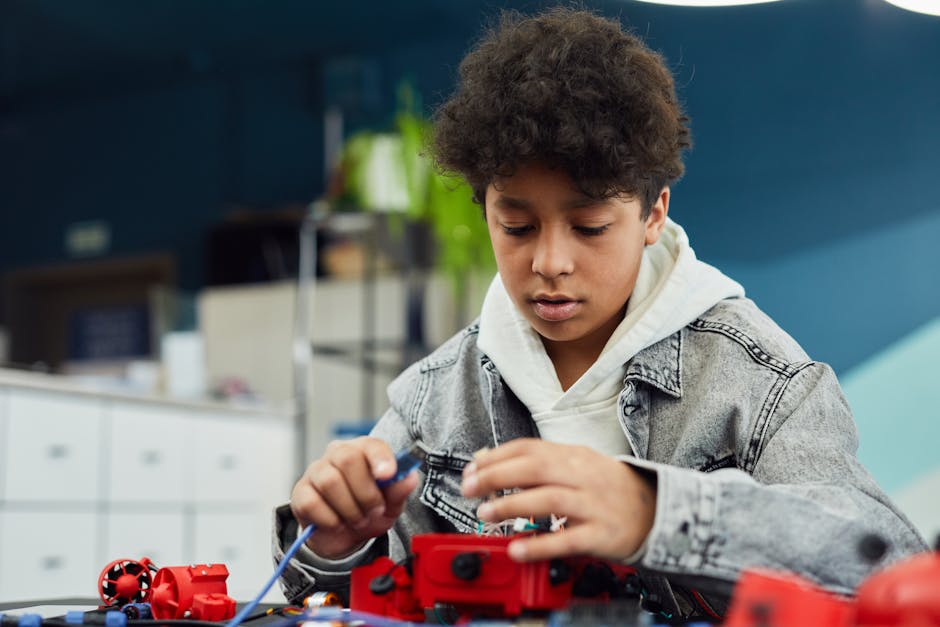
- Resilience and Growth Mindset: There’s arguably no better teacher of a growth mindset than debugging code or rerunning a failed experiment — failure is literally part of the process.
💡 Realistic Alternatives: Not Every Path Looks the Same
Here’s where I want to be honest with you, because a lot of STEM advocacy can feel tone-deaf to real-world constraints. Not every family has access to well-funded STEM programs. Not every child thrives in a traditional science-class format. And frankly, not every adult has the bandwidth for a full career pivot. So let’s talk realistic options:
For parents with limited school resources: Platforms like Khan Academy (completely free), Scratch (MIT’s visual coding tool for kids), and Code.org offer legitimate, structured STEM learning that rivals many classroom programs. Spending 30 minutes three times a week on these is more impactful than sporadic expensive camps.
For kids who “don’t like math”: The framing matters enormously. Cooking involves precise measurement and chemical reactions. Sports analytics is applied statistics. Game design is geometry and physics. Finding the STEM angle in what your child already loves is far more effective than forcing abstract textbook problems.
For adults pivoting careers: You don’t need a CS degree. In 2026, credentialed micro-learning paths — like Google’s Career Certificates, IBM’s AI Fundamentals badge, or community college data analytics programs — are genuinely respected by employers and completable in 6–12 months at a fraction of traditional tuition cost.
For the humanities-minded student: Consider STEAM (the A stands for Arts). Many of the most innovative roles in 2026 — UX research, science communication, health informatics, environmental policy — sit exactly at the intersection of technical literacy and humanistic thinking. You don’t have to choose sides.
The bottom line is this: STEM education isn’t a single road — it’s a landscape of on-ramps. The important thing is finding the one that fits your specific situation and starting.
Editor’s Comment : What strikes me most, after digging deep into this topic, is that the conversation around STEM in 2026 has matured past the “code or be left behind” panic of a decade ago. The real insight now is that STEM education is fundamentally about how to think — not just what to learn. The families and individuals who will thrive aren’t necessarily the ones who memorized the most Python syntax or calculus formulas. They’re the ones who learned to stay curious, test assumptions, and adapt when the answer isn’t in the textbook. That’s a skill every single person — regardless of age, background, or zip code — can cultivate. And honestly? That’s a pretty hopeful message.
태그: [‘STEM education 2026’, ‘future jobs and skills’, ‘children coding and robotics’, ‘STEM career preparation’, ‘computational thinking’, ‘education technology trends’, ‘STEM for kids and adults’]
Leave a Reply