Picture this: It’s a Tuesday morning in Seoul, and a middle school teacher named Ms. Park isn’t standing at the whiteboard explaining quadratic equations. Instead, she’s walking between students who are each working through a personalized AI-generated problem set — one tailored exactly to their current skill gaps. Her job today? To notice that one student in the corner looks frustrated not because of math, but because something happened at home. That’s something no algorithm can catch.
This scene isn’t futuristic fiction — it’s happening in classrooms right now in 2026, and it’s raising one of the most important questions in education: If AI can teach content better and faster than humans, what exactly is the teacher’s job now? Let’s think through this together, because the answer is both more nuanced and more hopeful than the headlines suggest.
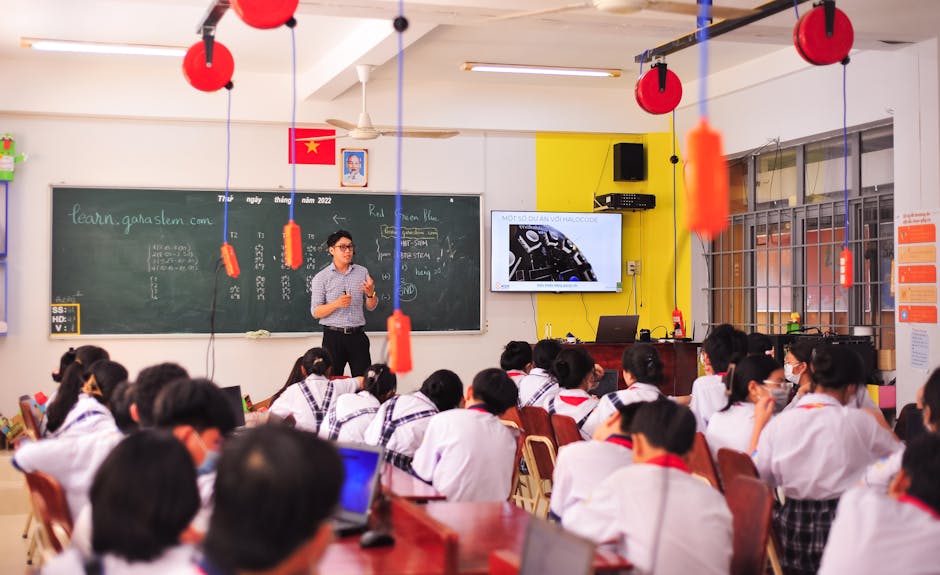
📊 The Numbers Tell a Complicated Story
Let’s ground this in data first. According to the OECD’s 2025 Education at a Glance report, over 67% of schools in high-income countries had integrated some form of AI-assisted learning tools into their curriculum by the end of 2025. In South Korea, the Ministry of Education’s AI Digital Textbook rollout — which began in earnest in 2025 — reached approximately 40% of elementary and middle schools by early 2026, with full deployment targeted for 2027.
Meanwhile, a McKinsey Global Institute analysis from late 2025 estimated that roughly 20–30% of traditional teaching tasks — including content delivery, basic quiz grading, and progress tracking — are now automatable with current AI tools. That sounds alarming on the surface. But here’s the logical flip side: the tasks that remain are precisely the ones that define exceptional teaching.
🔄 From “Sage on the Stage” to “Architect of Experience”
The old model of teaching — stand up front, deliver information, test recall — was already under pressure before AI arrived. What AI has done is accelerate the inevitable. Let’s break down how the role is actually shifting:
- Content Delivery → Learning Design: Teachers are increasingly becoming curriculum architects who design meaningful learning journeys, choosing when and how AI tools support versus when human interaction is essential.
- Assessment → Mentorship: With AI handling formative assessments in real-time, teachers can redirect their energy toward deeper one-on-one mentoring conversations about growth mindset, career paths, and personal development.
- Classroom Manager → Emotional Intelligence Specialist: Social-emotional learning (SEL) has surged in importance. A 2025 Harvard Graduate School of Education study found that teacher-student relational quality is now the single strongest predictor of long-term student outcomes — more so than test scores.
- Solo Instructor → Tech Collaborator: Today’s teachers need to know how to critically evaluate AI output, flag biases in algorithmic recommendations, and teach students to do the same. That’s a sophisticated new skill set.
- Information Gatekeeper → Critical Thinking Coach: In a world drowning in AI-generated content, the teacher’s role in modeling how to question, verify, and synthesize information has never been more vital.
🌍 What’s Actually Happening in Classrooms Around the World
Let’s look at some real examples, because theory only gets us so far.
Finland (2026 pilot): Several Helsinki schools are running a “Teacher as Coach” model where AI platforms handle 60% of direct instruction time. Teachers use the freed-up hours for what Finnish educators call kohtaaminen — meaningful human encounters. Early results show improved student wellbeing scores and sustained academic performance.
South Korea: The AI Digital Textbook initiative has been a fascinating case study. Early feedback from the 2025 pilot schools revealed something unexpected — teachers initially felt deskilled, as if the AI was replacing their expertise. But schools that invested in professional development to help teachers interpret AI data and build on it saw teacher satisfaction recover significantly. The lesson? Technology without teacher training is a recipe for anxiety, not progress.
United States (Arizona & Georgia): Several charter school networks have introduced “micro-credentialing” for teachers in AI literacy — short, competency-based certifications in areas like prompt engineering for education, AI ethics facilitation, and data-driven differentiation. These are becoming increasingly sought-after qualifications in 2026 hiring cycles.
India (Andhra Pradesh): With a teacher shortage affecting millions of students, AI tutoring platforms like BYJU’s next-gen tools are supplementing instruction in under-resourced schools. Here, AI isn’t replacing teachers — it’s filling a gap where teachers simply don’t exist in sufficient numbers. It’s a powerful reminder that the AI-teacher dynamic looks very different depending on context.

⚠️ The Real Risks We Shouldn’t Ignore
Being realistic means acknowledging the downsides too. There are legitimate concerns worth examining:
- Digital equity gaps: Schools with better infrastructure benefit more from AI tools, potentially widening existing inequalities between urban/wealthy and rural/low-income districts.
- Over-reliance on algorithmic assessment: AI can optimize for measurable outcomes while missing what’s truly important — creativity, resilience, ethical reasoning.
- Teacher burnout through role ambiguity: Many teachers in 2026 report feeling caught between two worlds — expected to be both tech-savvy AI curators AND deeply empathetic human mentors. Without institutional support, that’s an exhausting place to be.
- Data privacy: AI learning platforms collect enormous amounts of behavioral and academic data on minors. Governance frameworks are still catching up.
🛠️ Realistic Alternatives: What Can Teachers (and Schools) Actually Do?
Rather than waiting for top-down policy changes, here are practical, grounded approaches for educators navigating this transition in 2026:
- Start with one AI tool, not ten: Pick one platform (like Khan Academy’s Khanmigo, or a localized equivalent) and master it deeply before expanding. Breadth without depth creates confusion.
- Reframe your value proposition: Keep a “human touch journal” — document moments in your week where your presence, intuition, or relationship made a difference that no AI could. This builds professional confidence and clarity.
- Join a peer learning community: Teacher networks focused on AI pedagogy are growing rapidly. Organizations like ISTE (International Society for Technology in Education) and local educator guilds are hosting regular workshops specifically on human-AI co-teaching models.
- Advocate for protected non-AI time: Push for intentional curriculum spaces — discussions, debates, collaborative projects — that are explicitly designed to be AI-free. Students need those spaces to develop unassisted judgment.
- Get comfortable with discomfort: The transition is genuinely hard. Seeking coaching or counseling support isn’t a sign of weakness — it’s a sign of professionalism in a field undergoing rapid transformation.
The bottom line? The teachers who will thrive in 2026 and beyond aren’t those who resist AI or uncritically embrace it — they’re the ones who develop a clear, confident sense of what only they can offer. And that, it turns out, is quite a lot.
Editor’s Comment : What strikes me most when researching this topic is how the conversation has shifted. Two years ago, the dominant question was “Will AI replace teachers?” In 2026, the more sophisticated question being asked in schools, policy rooms, and faculty lounges is: “How do we redesign the teaching profession so that AI handles the transactional parts, and humans double down on the transformational ones?” That reframing feels not just more accurate — it feels more hopeful. Teachers aren’t becoming obsolete. They’re becoming something more specific, more intentional, and honestly, more important than ever. The classroom of the future needs both brilliant algorithms and brilliantly human educators. Let’s make sure we’re building systems that value both.
📚 관련된 다른 글도 읽어 보세요
- 유아 사회성 발달 놀이 방법 완벽 가이드 – 2026년 최신 육아 트렌드로 알아보는 우리 아이 친구 사귀기
- 2026년 AI 리터러시 교육, 학생이 반드시 갖춰야 할 핵심 역량 7가지
- 초등학생 자존감 향상 심리 치료, 어떻게 시작해야 할까? 2026년 최신 접근법 총정리
태그: [‘AI in Education 2026’, ‘Teacher Role Transformation’, ‘Future of Teaching’, ‘EdTech Trends’, ‘AI Digital Classroom’, ‘Education Innovation’, ‘Human-AI Collaboration in Schools’]
Leave a Reply