A colleague of mine — a middle school science teacher in Seoul — told me something that stuck with me during a conference earlier this year. She said, “I watch the brightest girls in my class slowly drift away from science by eighth grade. Not because they can’t do it. Because nobody ever told them it was for them.” That hit hard. And honestly, it’s what sparked this deep dive into what’s really going on with female participation in STEM — and more importantly, what we can actually do about it.
If you’ve been in education, tech, or policy circles for any amount of time, you’ve probably heard versions of this story. The problem isn’t new. But in 2026, we finally have enough longitudinal data, successful pilot programs, and real-world case studies to say: we know what works. Let’s dig in.

The Numbers Don’t Lie: Where the Gender Gap Actually Lives
Before we talk strategy, let’s ground ourselves in data. According to the UNESCO Science Report 2026, women represent only about 29% of researchers worldwide in science and engineering fields. In South Korea specifically, the Ministry of Science and ICT reported that female enrollment in computer science and engineering programs at the university level sits at roughly 22% as of early 2026 — slightly improved from previous years, but still far from parity.
More telling is the “leaky pipeline” phenomenon — a term educators use to describe how girls start out equally interested in science in early childhood but begin dropping out of STEM pathways around ages 11–14. A 2025 OECD PISA follow-up study found:
- Girls and boys perform equally in math and science at ages 9–10 across most OECD countries
- By age 15, girls are significantly less likely to express interest in STEM careers, even when they outperform boys academically
- Stereotype threat (the anxiety of confirming a negative stereotype about one’s group) accounts for up to a 20% performance drop in standardized science tests among girls who are primed with gender stereotypes
- Only 5% of female students in Korea and Japan identify engineering as their “dream job” compared to 26% of male students
- Girls from schools with active female STEM mentorship programs are 3.4x more likely to pursue STEM majors
The gap isn’t cognitive. It’s cultural and structural. That’s actually good news — because culture and structure can be changed.
Why Traditional Approaches Often Fall Short
Here’s something I’ve noticed after years of observing education reform efforts: well-intentioned programs often focus on “fixing” girls rather than fixing the environment. Pink coding camps, gender-segregated science fairs, or one-off “Women in STEM” poster campaigns miss the root cause entirely. They treat the symptom, not the disease.
Research from Stanford’s Clayman Institute (2025) actually shows that some gender-focused interventions can backfire — reinforcing the idea that girls need extra help, which itself can depress confidence and intrinsic motivation. The smarter approach is systemic and subtle.
Strategy 1: Early Exposure with Identity-Affirming Role Models
The most consistent finding across global research is this: representation matters enormously, and it matters early. A girl who sees a woman who looks like her solving engineering problems doesn’t just feel inspired — her brain literally recalibrates who STEM is “for.”
The “Girls Who Code” organization (girlswhocode.com) has run longitudinal studies on their alumni. Women who participated in their summer immersion programs are 15 times more likely to major in computer science than the national average. Their secret? They embedded female mentors into every single program touchpoint — not just as speakers, but as everyday coding partners and project advisors.
In Finland, the MakerGirls initiative (2024–2026) placed female engineers directly into elementary school classrooms for quarterly “maker days.” Schools that participated for two consecutive years saw a 40% increase in girls choosing advanced science electives in middle school. That’s a staggering return on a relatively low-cost intervention.
Strategy 2: Reframe STEM as Social Impact Work
Here’s a counterintuitive insight that comes up repeatedly in motivational research: many girls are deeply interested in science — they just don’t connect it to STEM careers as currently branded. When asked what they care about, girls disproportionately cite climate change, healthcare equity, mental health, and community development. When you reframe STEM as the toolkit for solving those problems, engagement shifts dramatically.
The WISE Campaign (UK-based, wisecampaign.org.uk) has been running a “People Like Me” strategy since 2014 with updated 2026 modules. The core idea: don’t sell engineering as building bridges — sell it as building a more equitable world. Their curriculum redesigns emphasize purpose-driven STEM applications, and schools using the updated materials reported a 33% increase in girls opting into engineering electives over two academic years.
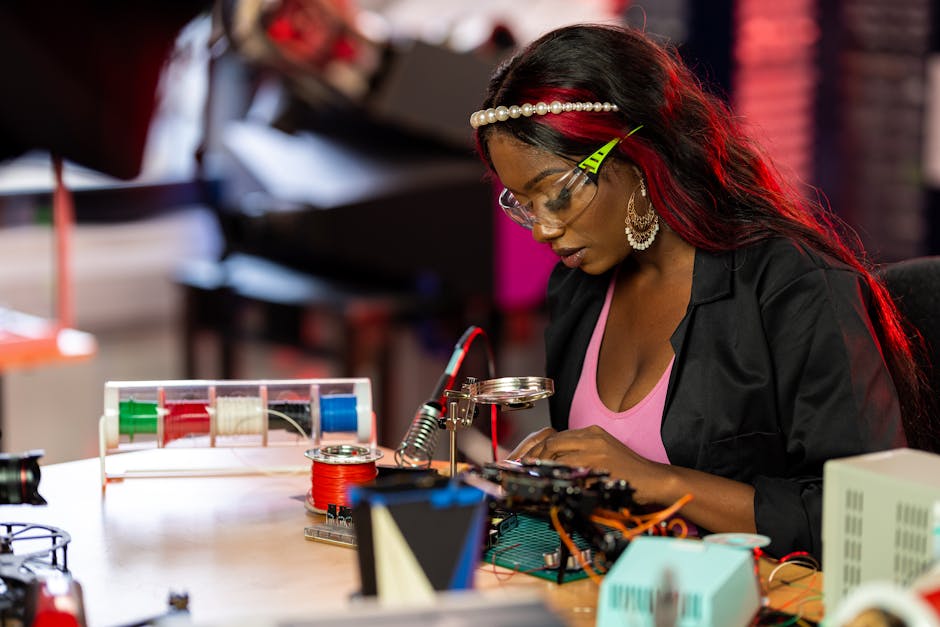
Strategy 3: Structural Reform in Assessment and Classroom Culture
This is where things get a little more technical — and a little more uncomfortable for institutions to tackle. Research from Harvard’s Project Implicit and the European Institute for Gender Equality (EIGE, 2025) confirms that unconscious teacher bias is a measurable factor in STEM participation gaps. In classrooms where teachers unknowingly called on boys more, praised boys’ “natural talent” while attributing girls’ success to “hard work,” girls’ self-reported STEM confidence dropped measurably over a single semester.
Strategies that address classroom culture head-on include:
- Collaborative, project-based learning over competitive, timed assessments — studies show girls perform comparably or better in collaborative settings but experience higher anxiety in head-to-head competition formats
- Anonymous grading systems for early STEM assessments to eliminate evaluator bias
- Growth mindset curriculum integration — Carol Dweck’s research shows that explicitly teaching that intelligence is expandable reduces stereotype threat effects by up to 40%
- Equitable wait time — training teachers to give all students equal think-time before calling on them, reducing the “quickest hand up” dynamic that tends to favor boys in math-heavy classes
- Normalize failure as learning — Maker/engineering culture often celebrates “breaking things,” but girls are socialized to avoid failure. Explicit destigmatization of error is crucial
Strategy 4: Family and Community Ecosystem Engagement
Schools can do a lot, but a girl goes home to her family every evening. Research published in the Journal of Vocational Behavior (2025) found that parental STEM expectations are the single strongest predictor of a daughter’s likelihood to pursue a STEM career — stronger even than teacher influence or peer groups.
Programs like STEM@Home by the Smithsonian (smithsonianmag.com) and Korea’s 융합인재교육(STEAM) 가족참여 프로그램 (Family STEAM Program) actively involve parents through quarterly family science challenges, workshops on how to encourage science curiosity at home, and — critically — myth-busting sessions where parents learn to recognize and counter gendered messages they unconsciously send about who is “naturally” good at math.
Strategy 5: Policy and Institutional Accountability
Finally, the macro level. Without institutional pressure and accountability mechanisms, individual efforts remain scattered. Countries seeing the most progress in 2026 are those that have tied STEM gender equity to measurable policy outcomes.
Notable examples:
- Canada’s Tri-Agency Research Equity, Diversity & Inclusion (EDI) Policy requires all federally funded research institutions to report gender participation metrics annually — non-compliance risks grant eligibility
- Germany’s Komm, mach MINT program (komm-mach-mint.de) now operates as a federal platform connecting over 1,200 STEM programs specifically for women and girls, with standardized impact reporting
- Singapore’s MOE introduced a 2026 update to its Digital Literacy Framework that explicitly tracks female student participation in advanced computing modules across all secondary schools — making the data visible was itself an intervention
- Corporate partnerships — companies like Samsung, LG, and Hyundai now tie portions of their CSR STEM sponsorship specifically to programs with demonstrated female participation growth metrics
Putting It All Together: A Layered Approach for 2026
The most successful programs I’ve seen don’t pick one strategy — they layer them. Think of it like debugging a complex system: you rarely fix the problem by touching just one variable. The interventions that move the needle are those that simultaneously address:
- Identity (who is STEM for?)
- Environment (is this classroom safe for me to fail in?)
- Purpose (does this connect to what I care about?)
- Community (do I see people like me succeeding here?)
- Accountability (is someone measuring whether this is actually working?)
If your school, organization, or policy team is just starting out, don’t try to do everything at once. Pick the layer where you have the most leverage right now — whether that’s teacher training, a mentorship pilot, or a curriculum redesign — and build from there. Incremental, evidence-based change compounds over time.
We’re at a real inflection point in 2026. The data is clear. The models exist. What’s needed now is the institutional will to implement them at scale — and the patience to let them work.
Editor’s Comment : Boosting female participation in STEM isn’t about lowering bars or creating special exceptions — it’s about removing the invisible ones that were never supposed to be there in the first place. The strategies above aren’t theoretical; they’re field-tested and data-backed. If you’re an educator, parent, or policy maker reading this, the most powerful first step is simply asking: “What message does my environment send about who belongs here?” Start there, and the rest follows.
📚 관련된 다른 글도 읽어 보세요
- 옆집 애는 왜 저렇게 당당할까? 아동 자존감 높이는 육아법 7가지 [2026 검증판]
- ChatGPT in the Classroom: Real-World Use Cases Transforming Education in 2026
- How to Raise a Child with High Self-Esteem: Proven Parenting Strategies That Actually Work in 2026
태그: STEM gender gap, female students STEM participation, girls in science education, STEM education strategies 2026, women in engineering, STEM mentorship programs, gender equity in education
Leave a Reply