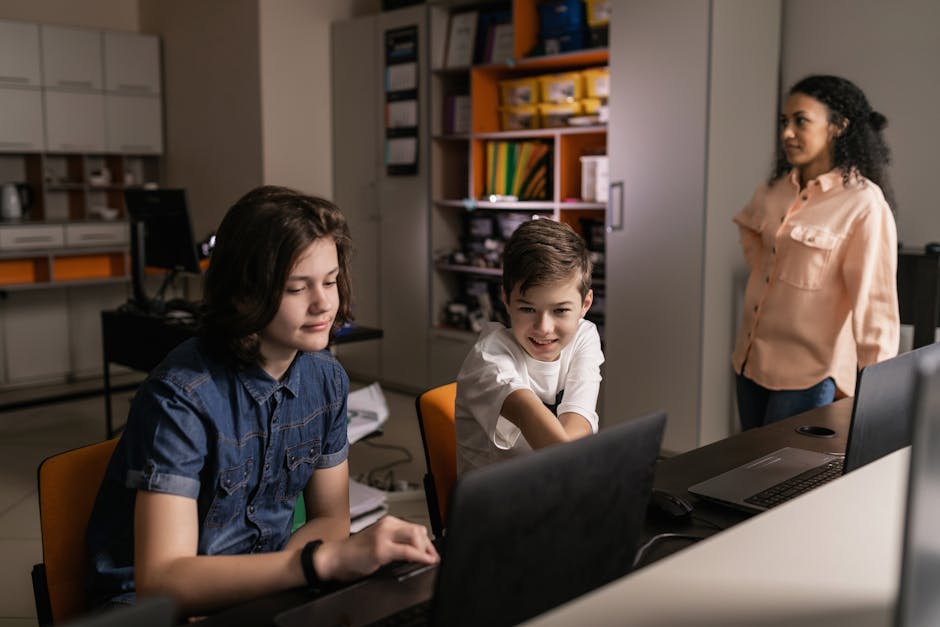
Picture this: It’s a Tuesday morning in a middle school English class. A teacher named Ms. Park asks her students to write a persuasive essay about climate change. Instead of the usual groans and blank stares, half the class opens their laptops and starts a conversation with ChatGPT — not to copy answers, but to brainstorm counterarguments they hadn’t considered before. By the end of class, the essays are richer, the debates are livelier, and Ms. Park is smiling. Sound too good to be true? In 2026, this scene is playing out in classrooms across the globe, and the teachers making it work have a few smart strategies in common.
So let’s think through this together — because using ChatGPT in a school setting isn’t as simple as handing students a powerful tool and stepping back. There’s real craft involved, and honestly, it’s one of the most exciting pedagogical puzzles educators are solving right now.
📊 Why ChatGPT in the Classroom Is No Longer Optional
According to a 2026 report by the OECD Education at a Glance survey, over 68% of secondary schools in OECD member countries have adopted some form of AI-assisted learning tool in their curriculum — up from just 29% in 2023. In South Korea alone, the Ministry of Education’s 2026 Digital Education Transformation Initiative has officially integrated AI tutoring tools, including large language models, into national curriculum guidelines for grades 7 through 12.
Meanwhile, a Stanford Graduate School of Education study published in early 2026 found that students who used AI tools with guided instruction showed a 23% improvement in critical thinking scores compared to control groups — but only when teachers actively structured how the AI was used. That last part is key. Unstructured AI use in classrooms actually correlated with slightly lower retention. The tool matters less than the method.
🧠 The Core Principle: AI as a Thinking Partner, Not a Ghost Writer
Here’s the mindset shift that separates effective ChatGPT integration from academic chaos: the goal is to use ChatGPT as a Socratic sparring partner, not an answer machine. When students ask ChatGPT “What is photosynthesis?” they get a Wikipedia-style summary. But when they ask “Can you challenge my explanation of photosynthesis and find the weakest part of my argument?” — that’s where real learning ignites.
This distinction maps onto Bloom’s Taxonomy beautifully. ChatGPT excels at helping students move from the lower tiers (recall, comprehension) into the higher-order skills (analysis, evaluation, creation) — if teachers design prompts and tasks accordingly.
🌍 Real Classroom Examples from Around the World
Finland — Project-Based Inquiry: Schools in Helsinki have embedded ChatGPT into project-based learning modules where students use the AI to generate “devil’s advocate” perspectives on their research topics. Teachers report that students now anticipate objections to their arguments before presenting, a skill that used to take years to develop naturally.
South Korea — Personalized Feedback Loops: Under the 2026 AI-Education pilot program in Gyeonggi Province, teachers assign written drafts and have students run their work through a structured ChatGPT prompt — “Give me three specific suggestions to improve this paragraph’s logical flow” — before peer review. This two-step process has reduced teacher grading time by roughly 30% while increasing student revision rates.
United States (New York City Public Schools): After briefly banning AI tools in 2023, NYC schools reversed course and now require all 9th-grade teachers to complete a 12-hour “AI Pedagogy” certification. Classrooms use ChatGPT for Socratic seminars, where AI-generated counterarguments are printed and debated without students knowing which side was AI-written — sharpening their ability to evaluate source quality.
Singapore: The Ministry of Education’s “AI Literacy” framework, updated in 2026, teaches students to critically audit ChatGPT’s outputs for bias and factual accuracy as a core component of digital citizenship class.
✅ Practical ChatGPT Teaching Methods You Can Use Tomorrow
- The “Prompt Design” Assignment: Have students write a complex prompt for ChatGPT, then evaluate whether the output matches what they intended. This teaches precision in communication and exposes how vague thinking leads to vague results.
- AI Devil’s Advocate: Students submit their thesis statement; ChatGPT generates the strongest possible counterargument. Students must then write a rebuttal — without AI help.
- Reverse Engineering Lesson: Give students a ChatGPT-generated paragraph on a topic they’ve studied. Ask them to fact-check every claim. What’s accurate? What’s missing? What’s subtly wrong?
- Collaborative Storytelling with Constraints: In creative writing, students write odd-numbered paragraphs; ChatGPT writes even ones. Students must then revise the AI’s paragraphs to match their voice and intent.
- Differentiated Learning Support: Struggling students can ask ChatGPT to “explain this concept three different ways” or “use a sports analogy to describe this math concept” — personalizing explanations without demanding extra teacher bandwidth.
- Exit Ticket Reflection: At the end of class, students write a 3-sentence reflection: What did I learn? What did I ask ChatGPT? Would I trust its answer? Why or why not?
⚠️ Realistic Challenges and How to Navigate Them
Let’s not pretend this is all smooth sailing. Three legitimate concerns come up repeatedly in teacher communities in 2026:
1. Academic Integrity: The concern is real, but the solution isn’t prohibition — it’s task redesign. Assignments that require personal reflection, in-class oral defense, or documented process portfolios are far harder to outsource entirely to AI. Think of it less as “can I catch AI use?” and more as “have I designed a task where AI use alone isn’t sufficient?”
2. Digital Equity: Not every student has consistent internet access or devices. Schools implementing ChatGPT tools need to pair them with offline alternatives — structured debate cards, printed prompt worksheets — so no student is disadvantaged by connectivity gaps.
3. Over-Reliance: There’s a real risk of students losing confidence in their own thinking. The antidote is building in frequent “AI-free” drafting sessions where students must produce initial ideas independently before consulting the tool. Think of ChatGPT as a second draft resource, not a first draft crutch.
🔄 Realistic Alternatives for Different School Contexts
Not every school is ready for full ChatGPT integration — and that’s completely okay. Here are tiered alternatives depending on your context:
- Low-tech alternative: Use printed ChatGPT conversation transcripts (generated by the teacher beforehand) as classroom discussion materials. Students analyze, critique, and debate without needing devices.
- Moderate integration: Allow ChatGPT access only during specific “research phases” of a project, with clear documentation requirements (students must log every prompt they used and why).
- Full integration: Develop a classroom AI use policy co-created with students — this itself is a powerful critical thinking exercise about ethics, consent, and intellectual responsibility.
The beauty of this tool in 2026 is that it’s flexible enough to meet teachers where they are, not the other way around. Whether you’re a veteran educator cautiously dipping a toe in, or a tech-forward teacher ready to redesign your entire curriculum, there’s a version of this that works for you.
Editor’s Comment : The schools winning with ChatGPT in 2026 aren’t the ones with the most devices or the biggest budgets — they’re the ones where teachers have been given time, trust, and training to think creatively about what learning is actually for. ChatGPT doesn’t replace the magic of a great teacher. But in the hands of one? It’s a remarkable amplifier.
태그: [‘ChatGPT in classroom 2026’, ‘AI teaching methods’, ‘ChatGPT education guide’, ‘AI tools for teachers’, ‘classroom technology 2026’, ‘critical thinking with AI’, ‘digital literacy education’]
Leave a Reply