A few months back, I was chatting with a parent at a robotics club meetup — her daughter had just won a regional coding competition, and instead of celebrating, the mom looked genuinely worried. “What’s the point?” she said. “By the time she graduates, AI will have taken half those jobs anyway.” That conversation stuck with me. It perfectly captures the anxiety millions of families are wrestling with right now: How do we prepare kids for jobs that don’t exist yet?
It’s a fair concern. But here’s the thing — the answer isn’t to panic and pivot away from STEM. The answer is to rethink how we’re teaching it. Let’s dig into that together.
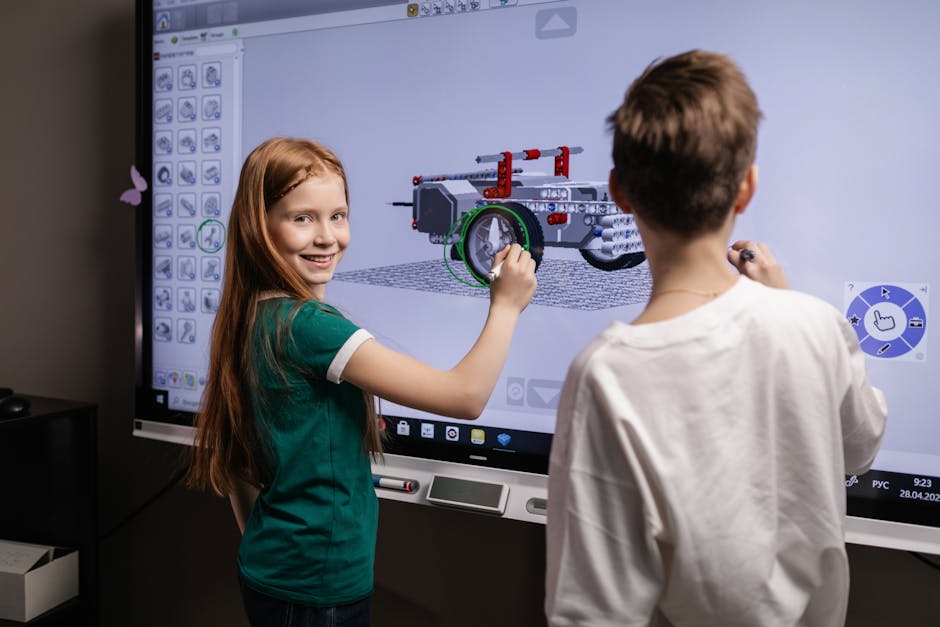
Why the “Old” STEM Playbook No Longer Works
For most of the 2010s, STEM education strategy was pretty straightforward: teach kids to code, get them into math competitions, push toward engineering or computer science degrees. That made sense at the time. But the labor market of 2026 looks radically different.
According to the World Economic Forum’s Future of Jobs Report 2026, approximately 85 million jobs will be displaced by automation by 2030, but 97 million new roles are projected to emerge — roles that blend technical skills with human-centered competencies. Meanwhile, a McKinsey Global Institute analysis released earlier this year found that generative AI tools now handle roughly 40% of routine coding and data analysis tasks that junior developers used to perform.
What does this mean practically? Simply drilling kids in syntax or rote formulas isn’t going to cut it. The STEM education conversation needs to evolve from “what” to “how” and “why.”
The 4 Pillars of Future-Oriented STEM Education in 2026
After years of watching educational trends, sitting in on curricula reviews, and honestly — being a parent myself who’s gone through trial and error — here’s what I believe the framework needs to look like:
- Computational Thinking Over Syntax Memorization: Teaching kids how to break problems into logical steps matters far more than memorizing Python commands. Tools like AI copilots (GitHub Copilot, Google Gemini Code Assist) already handle syntax — but they can’t replace structured problem-solving instincts.
- Cross-disciplinary Integration (STEAM+): The “A” for Arts isn’t just fluff. Research from Stanford’s d.school shows that students who combine design thinking with STEM principles produce solutions with significantly higher real-world applicability. Add in social sciences and ethics — we’re now talking STEAM+ frameworks.
- AI Literacy as a Core Competency: Kids need to understand AI not just as a tool but as a system with biases, limitations, and societal implications. MIT’s AI Education project (ai4k12.org) has produced excellent K-12 frameworks around this, freely available for educators.
- Human-Centered Skills Embedded in STEM Contexts: Communication, collaboration, ethical reasoning — these aren’t “soft” add-ons anymore. The U.S. Bureau of Labor Statistics projects that roles requiring a combination of technical expertise AND interpersonal skills will grow 2.5x faster than purely technical roles through 2032.
- Project-Based Learning (PBL) with Real Stakes: Simulated projects are fine for basics, but genuine community-connected problems (local environmental data analysis, accessibility design for schools) create motivation and depth that worksheets simply can’t replicate.
- Early Exposure to Emerging Fields: Quantum computing fundamentals, biotech engineering, climate tech, and spatial computing (AR/VR development) are no longer niche — they’re the frontier where jobs are being created right now.
What Schools and Programs Are Actually Doing Right in 2026
Let’s ground this in real examples, because theory without proof is just noise.
Finland’s National Curriculum Refresh (2025–2026): Finland — already a global benchmark for education — rolled out its updated curriculum in late 2025, embedding AI literacy and sustainability-focused engineering projects starting at age 9. Early feedback from the Finnish National Agency for Education shows a 32% improvement in student engagement scores in STEM subjects within the first academic year.
Singapore’s Smart Nation Junior Program: Singapore’s Ministry of Education expanded its Smart Nation Junior initiative, introducing quantum computing awareness modules at the secondary school level. Students work with IBM Quantum’s educational platform (quantum-computing.ibm.com) to run actual quantum circuits — simplified, but real. It’s remarkable what 14-year-olds can grasp when you stop underestimating them.
Khan Academy’s Khanmigo for STEM Tutoring: In the U.S., Khan Academy’s AI tutor Khanmigo has been integrated into over 15,000 schools as of early 2026. What’s interesting is the pedagogical approach: Khanmigo is deliberately designed NOT to give direct answers, but to ask Socratic questions — reinforcing the computational thinking pillar we talked about earlier.
South Korea’s SW·AI Education Mandatory Policy: South Korea made software and AI education compulsory across all grade levels by 2025. The Korean Ministry of Education reported that schools using maker-space environments alongside traditional AI instruction saw students develop 40% stronger collaborative problem-solving metrics compared to lecture-only cohorts.
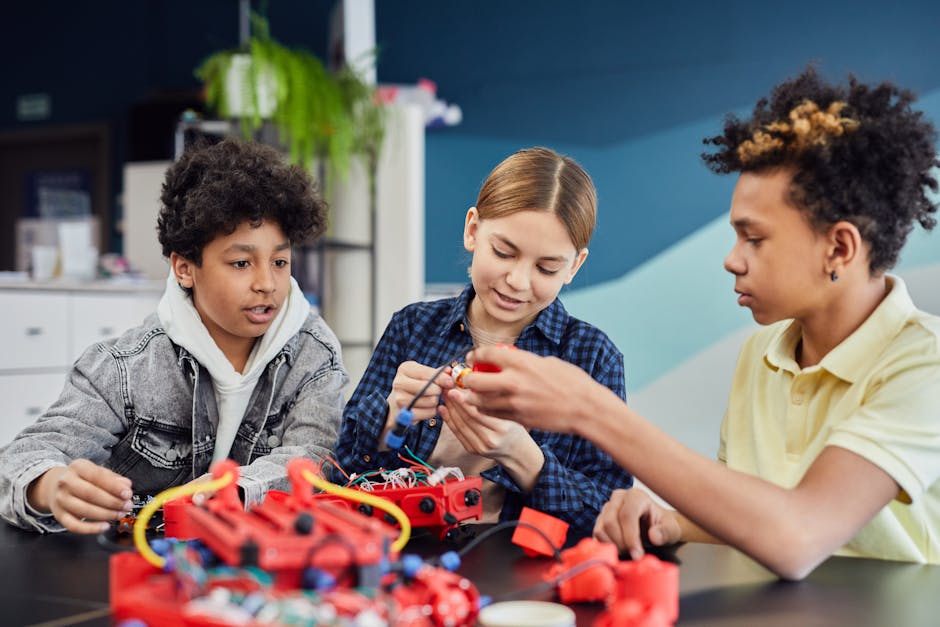
Practical Strategies for Parents and Educators Starting Today
You don’t need to wait for policy changes or curriculum overhauls. Here’s what you can act on immediately:
- Introduce AI tools transparently, not as cheating tools: Let kids use ChatGPT or Claude — but challenge them to critique, fact-check, and improve the AI’s output. This builds critical AI literacy organically.
- Find local maker spaces: Websites like Makerspaces.com and your local library systems often have free or low-cost access to 3D printers, laser cutters, and electronics kits.
- Prioritize programs like FIRST Robotics or VEX IQ: These aren’t just robot competitions — they’re project management, teamwork, and engineering design rolled into one. The skills transfer is exceptional.
- Explore online platforms with depth: MIT OpenCourseWare (ocw.mit.edu), Coursera’s university-level STEM courses, and Brilliant.org all offer rigorous content with self-paced flexibility for motivated learners of any age.
- Ask “what problem does this solve?” — constantly: This one habit shifts a child’s relationship with technology from passive consumer to active creator. It’s deceptively simple and incredibly powerful.
The Jobs You Should Actually Be Preparing For
Without getting too speculative, the roles that are genuinely growing — and will continue growing through 2030 — include:
- AI Prompt Engineers and AI Systems Auditors — quality-controlling AI outputs is a major growth area
- Climate Tech Engineers — renewable energy systems, carbon capture technology, sustainable architecture
- Biotech and Computational Biology Specialists — the intersection of biology and data science
- Human-AI Interaction Designers — UX but deeply specialized for AI-driven interfaces
- Quantum Computing Technicians — still emerging, but already being hired by IBM, Google, and IonQ
- Spatial Computing Developers — building for AR/VR/MR environments as Apple Vision Pro and its successors reshape interfaces
Notice that every single one of these roles requires not just technical knowledge, but the ability to communicate, collaborate, and think ethically. That mom at the robotics meetup was right to think critically — but the solution isn’t to abandon STEM. It’s to teach STEM differently: with more emphasis on thinking frameworks, human skills, and adaptability.
The goal was never to produce the best Python scripter in the room. The goal is to raise someone who can walk into an unfamiliar problem, think clearly, work with others, and create something new. That’s always been valuable. It’s just more visible now.
Editor’s Comment : If there’s one thing I’d encourage you to take away from all of this, it’s that the anxiety around AI displacing jobs is real but manageable — if we treat education as a living, evolving practice rather than a fixed checklist. The families and schools winning right now aren’t the ones with the most expensive gadgets or the most advanced coursework. They’re the ones asking better questions, building in more flexibility, and connecting STEM learning to things kids actually care about. Start there, and the rest tends to follow naturally.
📚 관련된 다른 글도 읽어 보세요
- How Play-Based Social Skills Education Transforms Kindergarten Kids in 2026: A Practical Guide for Parents & Educators
- 옆집 애는 다 하는데 우리 애만 모른다고? 유아 인지 발달 놀이 활동 7가지 + 연령별 효과 수치 [2026 최신]
- How Digital Devices Really Affect Child Development in 2026: What Parents Need to Know
태그: STEM education strategies, future jobs 2026, AI literacy for kids, STEAM learning, computational thinking, career-ready education, future skills children
Leave a Reply